
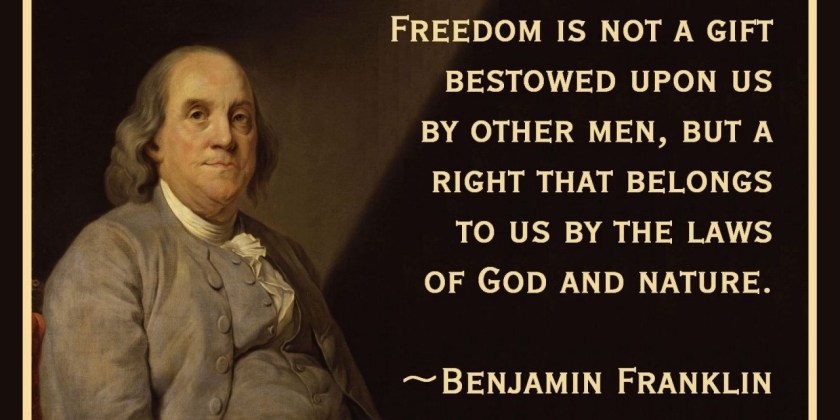
“Freedom is not a gift bestowed upon us by other men, but a right that belongs to us by the laws of God and nature.”
-Benjamin Franklin
Introduction
In my last two articles, I explored two core principles of an ideal government: limited, decentralized power and lower taxes. The third, and in my view most important core principle of government, is individual liberty. The basis of this principle can be found in the Declaration of Independence, which states that legitimate power of government must be derived only from the consent of the governed. At the time of the American Revolution, this was a radical notion differing greatly from the modern governments at the time and any government before. The American founders thought that liberty was a God given right, inherent in the nature of man, not given by any human authority. This attitude made it clear that rule under King George III and British Parliament was not only unwarranted, but was so contrary to human nature that a revolution and overthrow were justified. Read on to find why individual liberty is a necessity of just government.
History of Individual Liberty
As stated above, individual liberty holds a significant place in the founding of America. So basic is this principle, that it is found in the nature of man. Each person is a unique individual, not part of any group or political class. In fact, the American system was built as a republic so that individual rights could not be infringed upon, whereas in a pure democracy, individuals could potentially be ruled by a majority. One only needs to look to the 13th and 14th amendments and the American Civil War to understand individual liberty in the context of early America. The United States was divided on the right to own slaves in western territories during the expansion of the 1800s. So important was this right that the bloodiest war in American history was fought. The south thought that the federal government had no authority to restrict the ownership of slaves in the western territories. However, most of the northern colonies had already begun to abolish slavery. If one considers the founding principle of individual liberty, it is clear to see that the south was in the wrong. No man, not even an enslaved negro could be coerced into labor by another man unless he gave consent. This was true even though a common thought at the time was that slaves were not capable of taking care of themselves and therefore were better off being enslaved. This idea that slavery was a “positive good” was held mainly by southerners, most notably John C. Calhoun. However, this idea would be crushed by the newly formed anti-slavery Republican Party led by Abraham Lincoln.
Liberty is Explicitly Named in the Declaration of Independence
While the Constitution is the supreme law of the United States, the Declaration of Independence holds an important place in America as a statement on human rights. The second sentence of the Declaration proclaims that “all men are created equal, that they are endowed by their Creator with certain unalienable Rights, that among these are Life, Liberty and the pursuit of Happiness.” This specificity is important because it leaves no doubt that Liberty is among the utmost precious individual rights. Liberty in this context differs slightly from freedom, with the latter meaning to be unbound by restrictions. Freedom of religion, for examples, means that government cannot interfere with one’s religious practices or values. Simply put, freedom is being free from something or someone. Liberty, on the other hand, is being free to do something. In a political context, the opposite of liberty is tyranny. Most people would use these terms interchangeably. However, when it comes to freedom and liberty as natural rights, most people misunderstand the role of government in protecting these rights. Ted Cruz really nails the distinction in his debate with Bernie Sanders. In basic terms, a right, in regards to healthcare, bearing arms, to work, or otherwise, means that the government may not interfere with the exercise of that right. It does not mean that the government is responsible for providing these services. You are not entitled to a government issued pistol, healthcare services, or a job. You are entitled to the access to firearms, healthcare, and work.
Self-Determination is The Great Equalizer
One great thing to note about individual liberty is that it acts as a great equalizer among American citizens. As mentioned above, government has a role in securing individual rights in terms of access. That is to say that government cannot restrict certain things. This is, by definition, a negative liberty. I think if you polled most people in America today, then you would surely see a consensus about government involvement in individuals’ lives. Most people just want to be left alone. The founding fathers recognized that there exists a natural tendency in men to form groups and societies based on common morals and principles. Recognizing this, they felt it was of utmost importance to protect individual liberty from tyranny of a majority. Since liberty is an individual right and therefore cannot be infringed upon, it must be granted to everyone equally. A system set up in this way is the best for a few reasons. Firstly, it means that every person has equal access to determine his thoughts and actions according to his own plan. One cannot be subject to another’s will unless he consents to it. Secondly, this equality of opportunity is the only feasible way to level the playing field. This means that individuals will be unrestricted by artificial barriers. On the contrary is equality of outcome, which suggests that people ought to have the same things in life, such as income, healthcare, or housing. Bernie Sanders is a fan of this concept. This breaks down very quickly once you realize that individuals are blessed with different talents and abilities, and thus cannot be guaranteed the same results. For a government to do this would be impossible. Furthermore, it would mean transferring wealth from those who earn it, to those who do not. This is unjust on a very basic level. However, this is not to say that people with disabilities or those facing temporary hardship should be forgotten. Quite the contrary. What it does suggest is that the only feasible way for individuals to be equal, knowing what is true about the nature of man, is for government to secure equality of opportunity.
Liberty Begets Stable, Transcendent Societies
Do you ever wonder why the United States produces some of the best athletes, scholars, and artists in the world? Wonder no more: the answer is liberty. In a society that secures and promotes liberty, people are free to express themselves fully. Of course, there are practical limits on individual liberty. One cannot take action that would infringe on another’s rights. However, anything that does not harm the rights of others is fair game. What this means is that a diversity of expression, and most importantly a diversity of ideas, can be pondered and discussed openly. A citizen in the United States does not have to fear being jailed for creating a song that is critical of the government or for discussing key political issues. This brings to the table nearly limitless ideas open for rational discussion. Yes, this also means that extreme views might get to the forefront. However, these views can be dissected and ultimately rejected when liberty is guaranteed to both sides of the argument. What results is a society where nothing cannot be questioned and examined, and this allows society to seek truth and explore the most profound mysteries of human existence.
Conclusion
There are many core principles at the foundation of good government. Among the utmost of these are low taxes, decentralized power, and perhaps most importantly, individual liberty. All of these values have basis in the founding of America, and all are interrelated in that a reduction or removal of one, affects the others. The protection of liberty is of such high importance, it is no wonder why it is specifically referenced in the Declaration of Independence. Individual liberty exists as a part of the natural order of man, and thus is guaranteed to everyone. It promotes the open discussion of ideas, allows for individuals to be self-determinant, and helps societies to transcend seemingly any limits, be they self-imposed or otherwise.
 Liberty Matters
One thought on “Three Principles of my Ideal Government – Part Three- Limited, Individual Liberty”