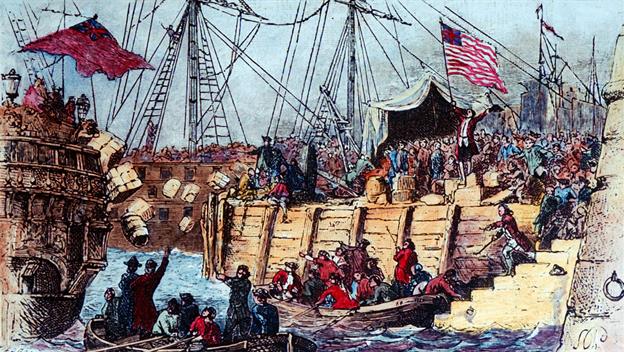
“We were merry, in an undertone, at the idea of making so large a cup of tea for the fishes.”
-Thomas Paine
Introduction
In my last article, I explored the historical place taxes held in the America Founding and why lower taxes are a necessary and logical component of a just government. On a related note is the principle of limited, decentralized government, which also has a historical significance in 1700s America. The problem during this time concerned British governmental overreach, meaning the actions taken by Parliament were not done so with representation by American colonists. Indeed, taxes can be used for good, so as long as those being taxed have a voice in the decision. With the British reach intruding endlessly from a centralized location on another part of the globe, it is easy to see why early colonists felt wronged by the actions of British Parliament. Read on to find why limited, decentralized power is critical to just government and individual liberty.
History of Limited, Decentralized Government
If you look back on the American Revolution, you will realize what a small, decentralized government meant to the founders. Starting in 1765, members of American colonial society rejected the authority of the British Parliament. Taxes and laws were being created without colonial representatives in the British government. Perhaps the most famous demonstration against such centralized, overreaching rule was during the Boston Tea Party, when patriots destroyed a shipment of tea by throwing it into the Boston Harbor. How did the British react? By imposing more punitive laws meant to make an example of the Massachusetts colonists who behaved badly. However, these laws had the opposite effect, and instead rallied other colonies in support of Massachusetts. This eventually snowballed into full-fledged revolution.
Small Government Can be Held Accountable
In a large, centralized government, it is very difficult to hold representatives accountable. Indeed, the day to day for Washington politicians is so very far removed from the average citizen living in the United States. Moreover, with so many aids, secretaries, and assistants caught up in the government machine, an elected representative has many others working for him, and thus has multiple people whom he can use to deflect blame should constituents be dissatisfied with his performance. This is also seen on a much larger scale when Congress abdicates its lawmaking duties and instead puts large agencies in charge of making laws. For example, the EPA is granted the power to make and enforce environmental laws. On top of this, it also serves as arbiter when citizens and businesses do not meet strict environmental standards. As such, when disgruntled voters express their woes, Congressmen simply point the finger at the institutions which have been established to essentially do their duties. In local governments, this is not typically the case. Those elected to local governments tend to deal more directly with constituents. Additionally, local issues tend to be more focused and therefore are less likely to be swallowed by massive bureaucracy.
Efficiency Increases as Government Decreases
In any system, group, or company, efficiency tends to decrease as the size and scope of these institutions increase. Local governments represent a smaller base and less numerous, more focused issues. With this, there is no need for an endless chain of assistants to help with multiple duties. The result is that these regional bodies are able to better address concerns and work more quickly to develop and employ solutions. If common problems such as crime, poor road conditions, or dishonest business practices are brought to light, representatives are bound to hear about it. With only a small scope of power and reach, local governments can better work to deliver results efficiently and without so much wasted funding being whitewashed through large administration, unlike the typical case of federal government, where one hand does not know what the other is doing.
Checks and Balances Matter
Large, centralized governments exist with a concentrated power. Because of this, they can more easily become corrupted than small, regional governments. When one cog in the machine becomes corrupted or unresponsive, this creates a ripple throughout the rest of a large system. However, because of the vastness of federal government, this systematic failure may go unnoticed for a significant length of time. In local governments, this is less of a problem. Poor performance can be recognized and dealt with swiftly. Moreover, there are many hoops one must jump through in order to remove a poor performer in the federal government. Job security is perhaps too secure in federal government, with only grievous offenses being grounds for removal. Some positions in government are held for a life term and/or require formal impeachment proceedings to remove someone who holds such a position. With local bodies, this is not the case. Because those who serve in local office are more directly involved with addressing the concerns of constituents in day to day tasks, failure to perform a specific duty has less of a chance of going unnoticed. When a local politician fails repeatedly, he is more likely to be held responsible and voted out of office.
Conclusion
Limited, decentralized power is an essential part of just government. Large, centralized power is tougher to control through checks and balances and is much more inefficient than local government. Moreover, locally appointed politicians have less bureaucracy to hide behind whenever they make mistakes, meaning it is easier to hold them accountable for unsatisfactory performance. Not counting military, the federal government employs nearly 1% of the total population of the United States, with only a small fraction of those personnel working for agencies of less than 100 employees. If individual liberty is to be preserved, a good place to start would be reducing this vast government. This concept of liberty will be explored in the third and final portion of my thoughts on ideal government.
 Liberty Matters
2 thoughts on “Three Principles of my Ideal Government – Part Two- Limited, Decentralized Power”